


Out Of Index 2025 interview: Please One More Block


Please One More Block은 플레이어들이 비실시간으로 서로를 돕고, 또 방해하는 플랫포머 게임입니다. 다른 플레이어에게 좋은 사람이 될 것인지 아닌지를 결정하는 것은 온전히 플레이어의 몫입니다.
Please One More Block is a platformer where players help—or hinder—each other in a non-real-time manner. Whether you choose to be a good ally or a mischievous opponent is entirely up to you.
1. 먼저 개발팀 소개를 부탁드립니다.
안녕하세요, 게임 프로그래머 하고 있는 더블즈비(Doublsb)와 챠로(Charo)입니다.
어릴 적부터 친구이자 같은 직종이 된 특이한 케이스인데, 협업 각을 보고 있다가 이번 Out of Index로 참가하게 되었습니다.
기획은 더블즈비, 아트는 챠로가 맡았고, 플랫포머 시스템 개발은 챠로가, 소셜 시스템 개발은 더블즈비가 맡았습니다.
Please introduce your development team.
Hi, we’re Doublsb and Charo. We’re childhood friends who ended up in the same profession, which is a bit unusual. We decided to collaborate and joined Out of Index with this project. Doublsb handled the game design, Charo handled the art, Charo developed the platformer system, and Doublsb worked on the social system.
2. 어떻게 이 게임의 아이디어를 처음 떠올리게 되었나요?
19년도에 처음으로 대형 이외의 게임 전시로 OOI를 관람하러 갔어요. 당시에 같은 컴퓨터에서 여러 사람들이 돌아가면서 게임을 하고 있는 것을 보고, 나름대로 충격을 받았어요.
저렇게 많은 사람들이 같은 컴퓨터로 같은 게임을 한다는게 흔한 상황은 아니잖아요. 어떤 사람은 뒤에서 게임 플레이를 지켜보면서 한마디씩 하기도 하고.
방에서 혼자 게임을 했으면 겪을 수 없는 재미라고 느꼈거든요. 그래서 생각했던 것 같아요. 전시에서만 할 수 있는 특별한 경험을 만들 수 있었으면 좋겠다.
생전 모르는 사람이지만, 이전에 플레이했던 사람이 다음 사람에게 영향을 주는 건 어떨까 싶었어요. 그걸 보여줄 수 있는 가장 직관적인 게임이 플랫포머라고 생각했고요.
이전 사람이 다음 사람에게 블록 하나씩을 전달하는 거예요. 그러면 어떤 맵이 완성될까요? 그 모습을 보고 싶었어요.
처음에는 '가장 많이 다른 플레이어를 죽인 사람'이나 '가장 많이 블록을 배치한 사람'에게 상을 준다는 느낌을 생각했었는데, 결과적으로는 지금이 가장 좋은 것 같아요. 모든 플레이어가 소외되지 않는 방식이라고 느꼈거든요. 경쟁으로 갔으면 그 행위만 반복하려고 했을 것 같고, 랭커들이 다른 사람들보다 더 좋은 경험을 가져가는 일이 생겼을 것 같아요.
How did you first come up with the idea for this game?
In 2019, I went to OOI for the first time to see a non-major game exhibition. I was impressed watching multiple people play the same game on the same computer, taking turns. That’s not a common situation, and some people would comment from behind while watching. It felt like a kind of fun you can’t experience when playing alone. That’s probably when the idea came to me — to create a special experience that only exists in an exhibition setting.
I wondered what would happen if a stranger, someone I didn’t know, could influence the next person playing. I thought a platformer was the most intuitive way to show that. The idea was that each previous player would leave one block for the next player. I wanted to see what kind of map would emerge.
At first, I imagined giving rewards to “the person who killed the most players” or “the person who placed the most blocks,” but eventually we realized the current system works best. It makes sure no player feels left out. If we went the competitive route, people would just repeat the same actions, and top players would get a better experience than everyone else.
3. 이 게임을 만들면서 어떤 것을 실험해보고자 하였나요? 실험 결과는 맘에 드나요?
게임 개발자로 일하면서 데이터를 많이 보게 됐어요. 플레이어가 의도한 대로의 순차적 액션을 수행하는가? 10분대에 플레이어는 무엇을 하고 있는가?
이러한 지표들을 보는 게 흥미로웠거든요. 이 결과들을 모아서 그래프 등으로 사람들에게 제공하면 나도 즐겁고 사람들도 영감을 얻는 부분들이 있을 것 같았어요.
Please One More Block에서는 인간은 다른 사람을 도울 수 있을 때, 어느 정도의 비율로 사람들에게 도움을 주려 할까? 이 부분을 측정할 수 있을 것 같았어요.
그리고 '좋아요'와 '싫어요'를 누르는 건 꽤 적극적인 행동이잖아요. 그게 어느 의도를 가진 블록에 몰릴지가 굉장히 궁금했어요.
실험 결과는... 아무래도 전시 당일에 알 수 있겠죠? 열심히 분석해볼게요.
What were you hoping to experiment with while making this game? Are you satisfied with the results?
Working as a game developer, I often look at data: do players perform actions in the intended sequence? What are they doing in the first ten minutes? It’s fascinating to watch.
Collecting this data and presenting it in graphs or other forms could be enjoyable for both me and the players, and even inspiring. In Please One More Block, we wondered: when humans can help each other, how often do they actually do it? That’s something we wanted to measure.
Also, hitting the ‘like’ or ‘dislike’ buttons is a pretty active choice. We were curious which blocks would attract more reactions. The results… we’ll probably find out on the exhibition day. We’ll be analyzing it carefully.
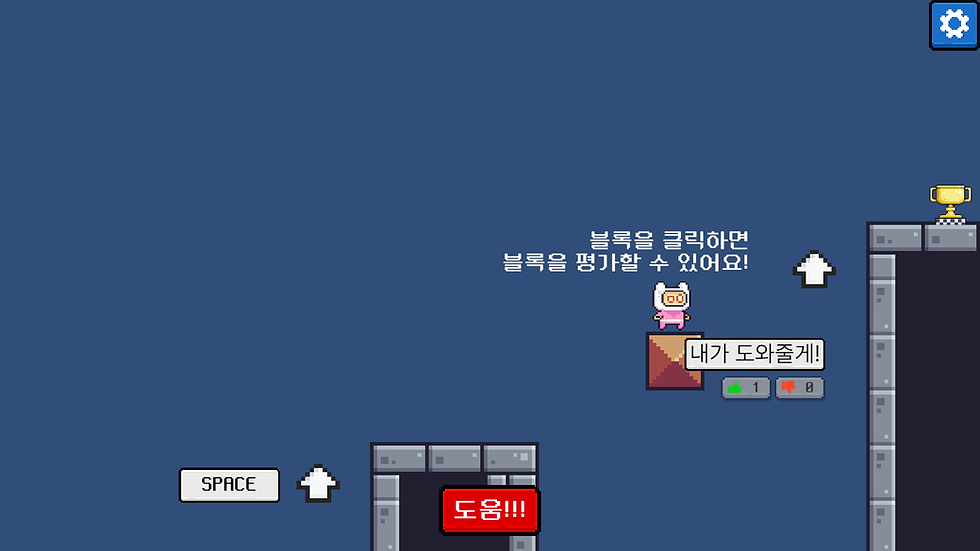
4. 게임 속에서 플레이어가 다른 플레이어들을 위해 맵에 배치할 수 있는 오브젝트 중에는 플레이에 도움이 되는 것도 있지만 방해물들도 많습니다. 이 게임의 목적은 플레이어 간의 협동을 통해 서로가 플랫포밍 레벨들을 클리어하는 것인데, 방해 요소를 배치하는 것은 사실 게임의 목표에 반하는 행위잖아요. 플레이어가 다른 플레이어를 방해할 수 있는 요소를 넣은 이유가 무엇인가요?
제가 생각하는 이 게임의 목적이 '남을 마냥 돕는다'라기 보다는, '남을 도울까? 말까?'랑 '누르면 날 돕나? 안 돕나?' 같은 불확실성이라서 그런 것 같아요.
튜토리얼에는 '이 버튼을 누르면 상대가 나를 도와줘요!' 라고 쓰여 있지만, 그건 처음 나타나는 블록을 보고 나면 '아 당연히 트롤링 하겠네' 라고 생각할 것 같았어요.
그렇다면 멀쩡하게 생겼지만 사실은 불쾌한 블록보다는, 보자마자 날 방해하는 블록이구나라고 직관적으로 느낄 블록들을 넣자고 생각했어요.
사악한 블록들은 오히려 가시화되면 그렇게 할 마음이 덜 들거라고 생각했거든요. 내가 기지를 발휘해서 사람들을 괴롭혀야지가 특별한 생각이 아니라 평범한 생각이 되니까요.
그리고 그냥 헬프 버튼을 눌렀을 때 나를 도와주는 블록만 나오면, 벌써부터 게임이 재미없는 느낌이 들지 않나요?
In the game, players can place objects that either help or hinder others. The goal is to cooperate to clear platforming levels, so adding obstacles seems counterintuitive. Why include elements that let players hinder each other?
The game’s purpose isn’t just to “help everyone.” It’s about uncertainty — “Should I help this person or not?” and “Will they help me if I press this?” The tutorial says “press this button and someone will help you,” but once players see the first blocks, they probably think, “Ah, of course, some trolling will happen.”
So we decided to include blocks that clearly act as obstacles rather than just looking innocent but secretly annoying. Making these mischievous blocks visible makes players less likely to do it unintentionally. It turns a special, clever idea into a normal, everyday thought.
Also, if pressing the help button always spawns helpful blocks, the game would feel less interesting from the start.
5. Please One More Block에서 중심으로 보이는 플랫포밍 게임플레이는 사실 부차적인 것이고, 그 안에서 여러가지 오브젝트를 만들며 서로를 돕거나 방해하는 행위가 게임플레이의 본질이라는 생각이 들었습니다. 거기에 한 발짝 더 들어가 각 플레이어의 행위를 서로 평가할 수도 있고요. 플레이어간의 소통을 끌어내기 위해서 고민한 것들엔 어떤 것들이 있나요?
네, 플레이어 간 영향을 준다가 메인 아이디어였으니까 기획 상 플랫포머 게임플레이는 사실 덤으로 따라오는 게 맞죠. 그치만 직관적이면서 분명한 목적의식을 줘요.
이게 단순한 플랫포머 게임으로 전락하지 않으려면, 이전 플레이어와 이후 플레이어 간의 상호작용을 잘 유도해야 이 모든 실험이 유기적으로 일어날 수 있겠다고 생각했어요.
그래서 이전 플레이어가 자신의 행위에 대해 어떻게 평가받았는지 볼 수 있는 부분이 꼭 필요하다고 생각했어요. 소울류 게임에서 남긴 코멘트가 '좋아요'와 '싫어요'를 받았을 때 즉각적인 피드백을 받으면 그 행위를 더 많이 하게 되잖아요. 마찬가지로 내가 게임에서는 벗어났지만 스마트폰으로 웹페이지에 가끔 접속해서 얼마나 많은 '좋아요'와 '싫어요'를 받았는지 체크할 수 있어야 한다고 생각했어요. 전시 당일을 위해 계획한 '가장 많이 좋아요를 받은 블록'의 스크린샷을 항상 모니터에 띄워 놓는 것도 소통을 유도하는 부분들이고요.
The core platforming gameplay is almost secondary — the real essence seems to be creating, helping, or hindering objects for others, and even evaluating each player’s actions. How did you design the game to encourage communication between players?
Since influencing other players was the main idea, the platformer gameplay is more like a bonus. Still, we wanted a clear and intuitive purpose. To prevent it from feeling like just another simple platformer, interactions between previous and next players had to be well-guided.
We made it essential for players to see how their actions were evaluated. Just like in Souls-like games, leaving a comment that immediately receives ‘likes’ or ‘dislikes’ encourages similar behavior. In our case, even after leaving the game, players can check via a webpage on their phone to see how many likes or dislikes their blocks received. For the exhibition, we planned to keep a screenshot of the “most liked block” on the monitor to encourage interaction.
6. 게임에 더 많은 플레이어들이 참여할수록, 각 레벨에 플레이어들이 추가한 오브젝트들이 계속 쌓이게 될 거잖아요. 결과적으로는 모든 레벨이 온갖 오브젝트들로 가득차버릴 것 같다는 생각이 들었습니다. 당연히 이 부분을 생각하면서 개발하셨을 것 같은데, 이 부분을 어떻게 해결하려고 하셨나요?
다른 플레이어가 설치한 오브젝트들은 '도움!' 버튼을 눌렀을 때에만 나타나요. 게다가 너무 멀리 있는 블록이 갑자기 튀어나오면 도움도 안 되고 화면에도 안 보이니까, 플레이어 반경에 있는 블록만 받아올 수 있도록 만들었어요. 같은 위치에 등록된 블록을 여러 개 생성할 수 없는 건 당연하고요. 너무 많이 헬프 버튼을 누르면 플레이어가 블록들과 방해로 인해 죽거나 움직이지 못하게 될 거고, 자연히 플레이어는 헬프 버튼을 난사하지 않을 거라고 생각했어요. 물론 난사하면 재미있긴 하죠. 그치만 플레이어가 원한 액션이니까, 자기 자신이 그 결과를 받아들여야겠죠.
With more players participating, levels could eventually be filled with objects. How did you handle that?
Only blocks within the player’s range appear when pressing the “Help!” button. Blocks that are too far away don’t appear and can’t help anyway. Multiple blocks in the same location can’t be created.
If a player presses the help button too much, they might get stuck or die due to the clutter, so naturally, they won’t spam it. Of course, spamming can be fun, but since it’s the player’s choice, they have to accept the consequences themselves.
[인터뷰: 박선용, 번역: 전재우]


댓글